You know you need coaching — but should that coach stand next to you in a gym, or review your training from your phone between meetings? Neither format is universally better. The right choice depends on how much hands-on instruction you need, how independently you can train, and how much your schedule can flex. Here is a clear personal trainer vs online coach comparison so you can decide with confidence — including when a hybrid approach makes sense.
Who This Guide Is For
This guide is for anyone comparing an in-person personal trainer with an online fitness coach — or wondering whether a hybrid of both is smarter than committing to one format forever.
- Beginners who have never learned barbell or dumbbell form
- Experienced lifters who need periodization more than hands-on teaching
- Busy professionals with unpredictable schedules or frequent travel
- Clients returning after injury or years away from training
- People who have abandoned gym memberships or online programs before
Personal Trainer vs Online Coach: Side-by-Side Comparison
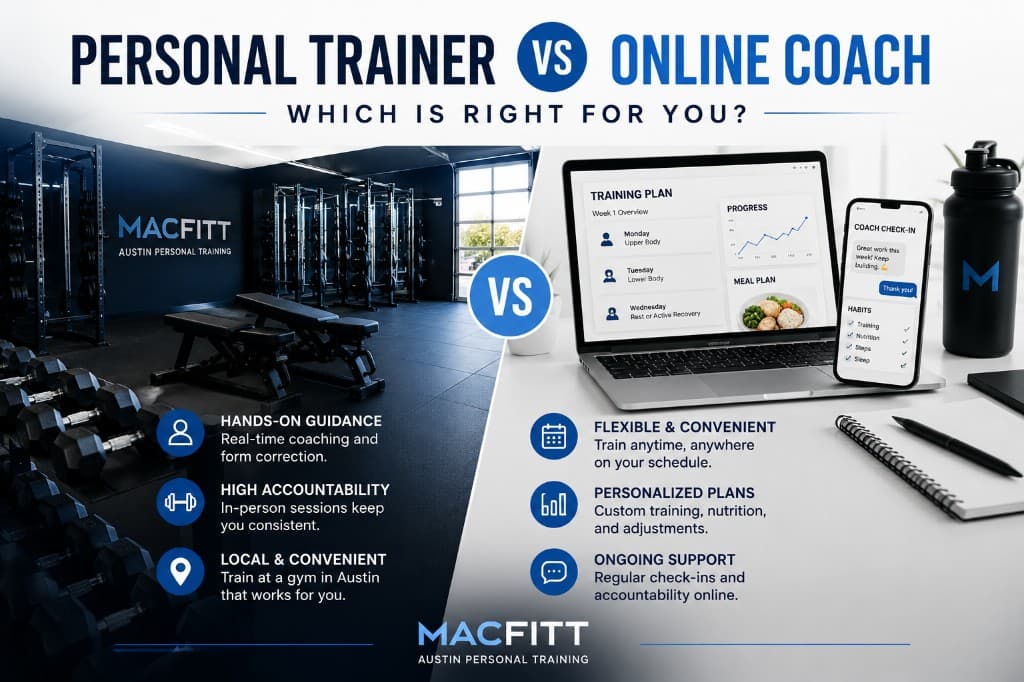
A personal trainer meets you at a gym — often a private facility or commercial location — and coaches you through each set in real time. An online coach delivers programming through an app or platform, reviews check-ins or video, and communicates by message or scheduled calls while you train on your own schedule.
| Factor | In-person personal trainer | Online coach |
|---|---|---|
| Cost structure | Usually priced per session or package | Usually priced as a monthly coaching program |
| Scheduling | Fixed appointment times | Train within program windows on your schedule |
| Accountability | Built into showing up for booked sessions | Depends on check-ins, messaging, and self-follow-through |
| Workout customization | Programmed and adjusted live in session | Custom programming updated from remote check-ins |
| Nutrition guidance | Often discussed in person between sets or check-ins | Delivered through targets, messaging, and reviews |
| Form feedback | Immediate, hands-on correction every set | Video or written cues — helpful, but delayed |
| Coach communication | Face-to-face during sessions | App messaging, check-ins, and occasional calls |
| Equipment | Trainer’s gym or agreed training location | Your gym, home setup, or travel facilities |
| Training location | Must be able to meet locally | Train anywhere you have space and equipment |
| Program adjustments | Made on the spot during the session | Made between sessions based on feedback and progress |
| Independence required | Lower — coach leads the session | Higher — you execute the plan on your own |
| Best suited for | Beginners, returners, and clients who need supervision | Self-directed clients who need flexibility and remote support |
For budgeting either format in Austin, see personal training cost and trainer prices. Compare what is included — programming, nutrition, and between-session support — not just the headline rate.
When an In-Person Personal Trainer Is the Better Choice
Choose in-person training when hands-on instruction, live supervision, and a fixed appointment are what will keep you progressing safely.
Real-time coaching catches compensations — a hip shift in a squat, a rounded back on a deadlift — before they become habits. The appointment itself creates accountability: you are far less likely to skip when someone is waiting for you than when a workout notification appears on your phone.
Choose in-person personal training when
- ✓Hands-on exercise instruction is a major priority
- ✓You want scheduled face-to-face sessions
- ✓You benefit from supervision during workouts
- ✓Local Austin training is practical for your commute and schedule
- ✓You are new to lifting, returning after injury, or rebuilding after years off
- ✓You need spotting or immediate form cues on compound lifts
If that describes you, Austin personal training with Jack is built for private one-on-one sessions with form coaching, strength programming, and nutrition guidance in a focused gym environment.
When an Online Fitness Coach Makes More Sense
Online coaching works well when you can train independently and need programming, nutrition guidance, and accountability that travel with your schedule.
Choose online coaching when
- ✓You need schedule flexibility more than fixed appointments
- ✓You can train independently with solid foundational form
- ✓You want programming, nutrition guidance, accountability, and remote support
- ✓You travel often or cannot consistently attend local sessions
- ✓You have a home gym or reliable commercial gym access
- ✓You will actually complete check-ins and respond to coaching feedback
If that is your situation, online fitness coaching through MacFitt delivers custom workouts, nutrition targets, weekly accountability, and direct messaging — without requiring in-person Austin appointments.
Accountability: Where Most People Underestimate the Difference
Accountability is often the deciding factor in a personal trainer vs online coach decision. External expectation — a person waiting for you — increases adherence for most adults.
In-person training embeds accountability structurally: you book, you show up, and the session happens whether motivation is high or low. Online coaching uses softer accountability — messages, app reminders, weekly check-ins. That works well for disciplined clients and fails quietly for people who stop responding without formally quitting.
| Mechanism | In-person trainer | Online coach |
|---|---|---|
| Scheduled appointments | Fixed times with cancellation policies | Flexible windows; easier to defer |
| Financial commitment | Per-session or package pricing | Monthly coaching subscription |
| Social pressure | Face-to-face relationship | Digital relationship; easier to ghost |
| Progress tracking | Logged live in session | Self-reported; requires honesty |
| Form oversight | Continuous during the session | Periodic video or written review |
Be honest about your history. If unused gym memberships are a pattern, online coaching alone may repeat it. If you reliably keep calendar commitments, online can be an excellent fit.
The Hybrid Approach Many Clients Use
You do not have to pick one format forever. A common path: start with several weeks of in-person training to learn movement patterns and build habits, then transition to online programming with occasional in-person check-ins.
Or train in person once or twice per week and complete an additional online-programmed session on your own. Hybrid models keep real-time coaching where it matters most — compound lifts and technique resets — while adding flexibility for sessions you can execute independently.
Hybrid coaching myths
How to Choose: A Simple Decision Guide
Start with your goal and an honest self-assessment. New to lifting or coming back after years off? Lean in-person first — see how to get back in shape after years off. Experienced and schedule-constrained? Online is often the better primary format.
- Define your primary goal: fat loss, muscle, strength, return from injury, or general fitness.
- Rate your movement experience honestly — beginner, intermediate, or advanced.
- Review your track record with self-directed programs and unused memberships.
- Decide whether fixed appointments help you or block you.
- Confirm whether local in-person training is practical week to week.
- Interview one in-person option and one online option before you commit.
- Start with a short trial window, then adjust based on adherence and progress.
Jack McNamara coaches both formats: private in-person personal training in Austin and remote online fitness coaching. Book a consultation if you want help matching the format to your goals — not a hard sell toward the more expensive option.
Common Mistakes When Choosing a Format
- Choosing online mainly to save money when you have never learned basic lifting form
- Assuming more in-person sessions is always better when one strong session plus online homework would suffice
- Treating a low-cost workout app as the same product as coached online programming with real check-ins
- Picking a format before defining your goal
- Ignoring your history with unused gym memberships and unanswered check-ins
- Staying stuck in research mode for months instead of running a short trial
Bottom Line
In-person personal training wins on form feedback, safety, and appointment-based accountability. Online coaching wins on flexibility, portability, and remote support for clients who can train independently. Hybrid splits the difference when you need teaching and schedule freedom.
Frequently Asked Questions
Often the monthly total is lower for online coaching than for multiple weekly in-person sessions, because pricing is usually structured as a monthly program rather than per session. That said, cheap workout apps are not the same as coached programs with real check-ins. Compare what is included — programming, nutrition, and accountability — and weigh cost against whether you will actually follow the plan.
Online coaches can review video and give cues, but they cannot physically spot you or correct a lift mid-rep. For heavy compound lifts, beginners, and injury returners, in-person coaching is generally safer. Experienced lifters with solid form can train well online with periodic video review.
Most beginners benefit from in-person coaching first so bracing, hinging, and squatting are coached in real time. After fundamentals are solid, transitioning to online coaching is often a smart next step. Starting online with no form foundation is a common reason people stall or get frustrated.
An online fitness coach is worth it when you can train independently, will complete check-ins, and need custom programming, nutrition guidance, and accountability more than hands-on spotting. It is usually not worth it if you consistently skip self-directed workouts or still need live form instruction on basic lifts.
Yes. Many clients start in person and move online as competence grows, or add in-person sessions when they want hands-on coaching for new movements. Discuss transition options with your coach before you assume the format is permanent.
It depends on the coach and package. Some include nutrition guidance; others charge separately or focus only on workouts. Always ask what is included before you commit. MacFitt integrates nutrition support into both in-person and online coaching.
At minimum, enough equipment to train productively — often dumbbells and bands, or access to a commercial or home gym. A good online coach programs around what you actually have, including hotel gyms when you travel, rather than assuming an ideal setup.