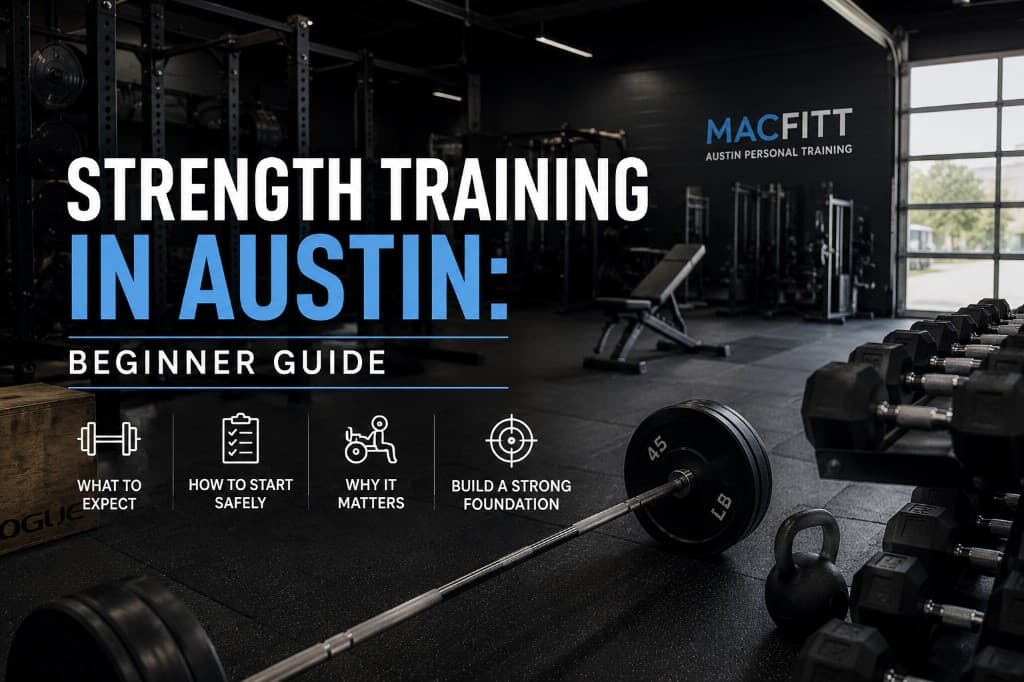
You bought the gym membership, watched three YouTube squat tutorials, and walked onto the floor at your Mueller or Domain gym feeling like everyone else already knew the secret handshake. Strength training in Austin does not have to start with embarrassment or a tweaked shoulder. Whether you are a busy professional in South Austin, a parent squeezing workouts between school drop-offs, or someone returning after a decade away from the barbell—the right beginner plan builds confidence before it builds muscle. That confidence is what keeps you showing up when January motivation fades and the heat index hits 105.
Why Strength Training Belongs in Every Austin Fitness Plan
Austin is an active city—trail runners on the Greenbelt, cyclists on Shoal Creek, pickleball courts packed on weekends. Cardio gets most of the attention, but strength training is the multiplier that makes everything else work better.
Lifting builds the muscle that raises your resting metabolism, supports your joints during hikes at Barton Creek, and preserves bone density as you age. For beginners, the goal is not to become a powerlifter. It is to build a body that handles real life: carrying groceries up stairs, playing with kids without back pain, and maintaining energy through long workdays.
Common beginner myths about lifting
Who This Is For
This guide is for anyone starting—or restarting—strength training in Austin. You are in the right place if:
- You have never lifted weights seriously and want a clear starting point
- You are returning after years off and need a safe reload—not your old college bro-split
- Cardio is your comfort zone but you know you should be lifting too
- Commercial gym floors intimidate you and you want a quieter learning environment
- You want fat loss or muscle building but do not know which movements matter first
- You are over 40 and want joint-friendly progressions with a strength coach or trainer
You may not need hands-on coaching forever—but the first eight to twelve weeks are when bad habits cement. A few months with a qualified Austin personal trainer pays dividends for years of independent training.
What to Expect in Your First Four to Eight Weeks
The first month of strength training in Austin feels different from what Instagram suggests. You will not max out every session. You will learn how to brace your core during a squat, set your shoulders before a row, and breathe through movements without holding your breath.
Soreness is normal for the first two weeks; sharp pain is not. Your nervous system adapts faster than your muscles, so strength gains in weeks three and four often surprise people who worried they were not progressing.
| Week | What you feel | What is actually happening |
|---|---|---|
| 1–2 | Soreness, uncertainty about form | Motor learning, connective tissue adapting |
| 3–4 | Movements feel more familiar | Neural efficiency improving, strength climbing |
| 5–6 | Less soreness, more confidence | Muscle protein synthesis increasing, habits forming |
| 7–8 | Ready for slightly heavier loads | Foundation set for progressive overload |
The Five Movement Patterns Every Beginner Should Learn
Good programming is built on movement patterns, not endless exercise variety. Every strength session should train some version of a squat, hinge, push, pull, and carry.
That does not mean five exercises every workout—it means your weekly training covers all five categories. A goblet squat covers squatting. A Romanian deadlift covers hinging. Push-ups or bench press cover pushing. Rows cover pulling. Farmer carries cover loaded carries. This framework scales from your first month to your fifth year.
Beginner strength session template
- ✓Warm up five to eight minutes: brisk walk, bike, or dynamic mobility
- ✓Squat pattern: goblet squat or box squat, 3 sets of 8–12
- ✓Hinge pattern: Romanian deadlift or kettlebell deadlift, 3 sets of 8–10
- ✓Push pattern: push-ups or dumbbell bench, 3 sets of 8–12
- ✓Pull pattern: cable row or dumbbell row, 3 sets of 10–12
- ✓Carry or core: farmer carry or dead bug, 2–3 sets
- ✓Cool down two to three minutes of easy breathing and stretching
Exercise selection should match your current ability, not your ego. Elevated push-ups beat sloppy floor push-ups. Box squats beat half-depth squats with a rounded back. An Austin personal trainer can regress or progress each movement in real time—something a printed program or app cannot do when your hip shifts or your shoulder drops during a set.
Training Safely in Austin's Heat and Busy Schedules
Austin summers are no joke. Training in a hot garage gym or a commercial facility with weak air conditioning affects performance and recovery. Hydrate before you arrive, not after you feel thirsty. Morning sessions beat lunch-hour workouts in July and August.
If you train outdoors—boot camps, CrossFit boxes with open bays—scale intensity on days above 95 degrees and watch for dizziness or nausea. Indoor private facilities with climate control remove one more barrier for beginners who already feel uncertain.
- Drink sixteen to twenty ounces of water one to two hours before training.
- Wear breathable clothing and avoid training in direct sun during peak heat.
- Reduce volume—fewer sets—on high-heat days rather than skipping entirely.
- Prioritize sleep; recovery is when strength actually builds.
- Schedule workouts like meetings: same days, same times, non-negotiable.
Common Beginner Strength Training Mistakes
Most beginner injuries and plateaus in Austin come from the same predictable errors—not from lifting being inherently dangerous:
- Adding weight before form is consistent across all reps
- Copying advanced lifters at the gym instead of following a beginner plan
- Training six days a week before recovery habits exist
- Skipping warm-ups because "it is just light weight"
- Doing only machines because free weights feel intimidating—then never learning real movement patterns
- Expecting the scale to drop immediately while building muscle (body composition changes lag behind strength gains)
| Factor | Do this | Avoid this |
|---|---|---|
| Frequency | 2–3 full-body sessions weekly | Daily lifting with no rest days |
| Load | Challenge with clean reps; leave 1–2 in the tank | Max out every exercise to "prove" progress |
| Learning | Film sets or train with a coach for feedback | Assume YouTube once equals mastery |
| Goals | Track reps, load, and energy levels | Compare yourself to strangers on the gym floor |
If you are coming back after time away, read how to get back in shape after years off—restart progressions differ from true beginner plans.
Commercial Gyms vs Private Training in Austin
Austin has no shortage of gym options—national chains, boutique studios, CrossFit boxes, and private training facilities. Commercial gyms work for self-directed people who already know proper form.
They are harder for beginners who need feedback, hate waiting for racks, or feel watched on the training floor. Private gym training offers appointment-only access, curated equipment, and one-on-one attention. The cost is higher than a monthly membership, but the learning curve is shorter and the injury risk is lower when someone qualified watches your setup on every set.
| Factor | Commercial gym | Private gym training |
|---|---|---|
| Coaching access | Limited unless you hire a trainer separately | Built into every session |
| Equipment availability | Wait times at peak hours | Dedicated equipment, no sharing racks |
| Learning environment | Crowded, potentially intimidating | Quiet, focused, beginner-friendly |
| Monthly cost | Lower membership fee | $85–$200+ per session; online from $300+/month |
| Best for | Experienced lifters who are self-sufficient | Beginners who want form coaching and accountability |
If you are comparing options, read our guide on how to choose a personal trainer in Austin and what personal training costs typically look like. Price matters, but value—measured in confidence, safety, and results—matters more for someone learning strength training from scratch.
Building a Strength Routine You Can Sustain
The best strength program is the one you still follow in October when the New Year's energy is gone. Start with two days per week if three feels overwhelming. Pair strength training with a daily walk rather than adding intense cardio on top of four lifting days.
Integrate nutrition that supports recovery—adequate protein, mostly whole foods, enough calories to fuel training. Nutrition coaching paired with lifting accelerates body composition changes for Austin clients who want fat loss and muscle gain at the same time.
The Bottom Line
Strength training in Austin starts with five movement patterns, two to three sessions per week, and form over ego. The heat, the busy schedule, and the crowded gym floor are real obstacles—but they are manageable with the right plan and environment.
You do not need to become a lifter overnight. You need eight to twelve weeks of consistent, coached repetition—and then strength becomes a habit that supports everything else you do in this city.
Pick two or three days this week. Learn the movement patterns. Train with weights that challenge you but allow clean reps. Track your sessions. And if the gym floor still feels overwhelming, get a coach for even four to eight weeks—that investment pays dividends for years.
Book a consultation at MacFitt's private gym in Austin. Review client results, explore muscle building coaching when you are ready to progress, or read about private gym training to compare options.
Frequently Asked Questions
Two to three full-body sessions per week is ideal for most beginners. That frequency allows adequate recovery while building motor patterns and strength. Four or more days often leads to fatigue and sloppy form before habits are established.
Not strictly, but a qualified trainer accelerates learning and reduces injury risk in the first two to three months. If you train alone, use conservative weights, film your sets, and prioritize form. Many Austin beginners start with coaching and transition to more independent training once patterns are solid.
Yes. Strength training preserves muscle during a calorie deficit, which keeps metabolism higher and improves how you look at a given weight. Pair lifting with sensible nutrition—not extreme restriction—for sustainable fat loss. See our weight loss coach guide for the full picture.
Wear comfortable athletic shoes with a flat sole or light training shoe, breathable clothing, and bring a water bottle. Avoid running shoes with thick cushioned heels for squatting and deadlifting if possible—they reduce stability. A towel and gym bag with a lock are useful at commercial gyms.
No. Clients in their fifties, sixties, and beyond benefit enormously from loaded movement with proper scaling. Start lighter, progress slower, and work with a coach who understands joint considerations. Strength training is one of the best tools for maintaining independence and bone density as you age.
Mild to moderate muscle soreness one to two days after a session is normal for the first few weeks. It should feel like tired muscles, not joint pain. Soreness decreases as you adapt. If you are too sore to train consistently, reduce volume—not effort on individual sets.
Use both if available. Machines can isolate muscles with less coordination demand. Free weights build stability and transfer better to real-life movement. A balanced beginner program includes primarily free weights with machines as supplements or regressions when needed.
Private in-person sessions typically run $85–$200+ depending on the trainer and facility. Online coaching with real check-ins starts around $300+/month. A commercial gym membership is cheaper—but without coaching, beginners often lose months to poor form. See personal training costs for comparisons.
Yes with dumbbells, resistance bands, and a bench you can learn the five movement patterns. Home works for maintenance once form is solid. Beginners benefit from barbell access and in-person feedback—a garage gym in August without AC is also a tough place to learn bracing. Private gym training solves both problems.